
Guide · Updated August 2026
How much does a septic system cost in Texas?
A conventional system on good soil is the cheap version. An aerobic system on tight clay is not. Here is what actually drives the difference — and who to call, because it is not us.
Call 940-567-8111 See what we do handle
Free on-site estimates · Jack, Wise, Young, Palo Pinto and Parker counties
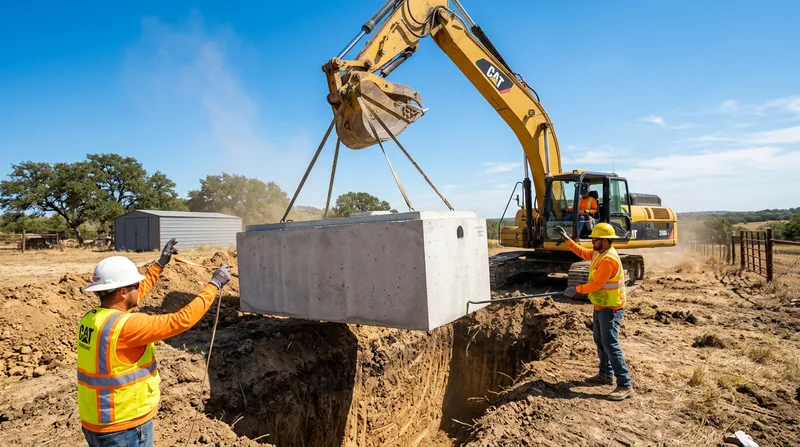
What does a septic system cost in Texas?
A conventional septic system on suitable soil generally starts around $6,000 to $10,000 installed, and an aerobic system typically runs $12,000 to $25,000. On top of that, expect a permit and a site and soil evaluation before anything is designed. The single biggest factor is your soil: ground that percolates well can take a conventional drain field, which is much cheaper. Tight clay, shallow rock or a small lot often forces an aerobic system with spray distribution, and that is where the price jumps.
What the two system types cost
| System type | When it is used | Typical installed cost | Ongoing |
|---|---|---|---|
| Conventional (anaerobic) | Soil percolates well, enough room for a drain field | $6,000 – $10,000 | Pump every 3–5 years |
| Aerobic (ATU) with spray | Tight clay, shallow rock, small lots, high water table | $12,000 – $25,000 | Required maintenance contract, plus electricity |
| Permit + soil evaluation | Required before either is designed | Several hundred to ~$1,500 | One-time |
| Tank replacement only | Existing field still good, tank has failed | Lower than a full system | — |
Ranges vary by county, soil, access and how far the truck has to drive. Treat these as planning numbers and get a quote from a licensed installer for your actual property.
Why your neighbor paid half what you were quoted
Soil is most of it
An on-site sewage facility works by letting treated effluent disperse into the ground. If your soil percolates, a conventional drain field does that job cheaply. If it does not — heavy clay, rock close to the surface, a high water table — the effluent has nowhere to go, and the system has to treat it far more thoroughly before releasing it above ground through spray heads. That is an aerobic system: more tanks, a compressor, electricity, controls, and a required maintenance contract for as long as you own the place.
Household size
Systems are sized on bedroom count and projected daily flow. A five-bedroom house needs meaningfully more tank and more field than a two-bedroom.
Lot size and setbacks
Drain fields have to sit a set distance from wells, property lines, structures and water. On a tight lot, there may simply not be room for the cheap option.
Access and site work
If equipment cannot get to where the system has to go, somebody has to clear and grade a way in first. That is the part we are sometimes involved with — clearing and grading around a system, never the system itself.
Permits are not optional
Texas on-site sewage facilities are regulated under TCEQ rules and permitted through the county or an authorized agent. A site and soil evaluation comes first, then a design, then a permit, then installation by a licensed installer, then inspection. A system installed outside that process is a serious problem when it fails — and a deal-breaker when you try to sell.
Common questions
How often should a septic tank be pumped?
Every three to five years for a typical household is the standard guidance, though it depends on tank size and how many people are using it. Pumping on schedule is cheap; letting solids carry into the drain field and ruin it is not.
What are the signs a septic system is failing?
Slow drains throughout the house, gurgling in the pipes, sewage backing up, an unusually green or spongy patch over the drain field, standing water or smell in the yard. Any of those means call a licensed septic company now rather than next month.
How long does a septic system last?
A properly sized, properly installed conventional system that gets pumped on schedule can run for decades. Aerobic systems have mechanical components — compressors, pumps, controls — that need service and eventual replacement, which is why the maintenance contract exists.
What should never go down a septic drain?
"Flushable" wipes — they are not. Also paper towels, feminine hygiene products, diapers, cooking grease and fats, paint and solvents, and large volumes of bleach. Grease and wipes cause more failures than anything else on that list.
Do I need a permit to replace an existing system?
Generally yes. Replacement is treated as new installation and goes through the same permitting. Your licensed installer will handle it.
Who do I call in Jack or Palo Pinto county?
We send septic work to a licensed OSSF installer, who hold the Texas OSSF installer license. If we are already on your property for dirt work and find a septic problem, we will tell you and get them out.
Need the ground worked instead?
Land clearing, grading, pads, drives, stock tanks and trenching across Jack, Wise, Young, Palo Pinto and Parker counties.