
Guide · Updated September 2026
How much does land clearing cost per acre in Texas?
Short version: $1,200 to $5,000 an acre in North Texas ranch country, and where you land depends mostly on how thick the growth is, the method, and what happens to the debris. Here is the long version.
Call 940-567-8111 Get a free estimate
Free on-site estimates · Jack, Wise, Young, Palo Pinto and Parker counties
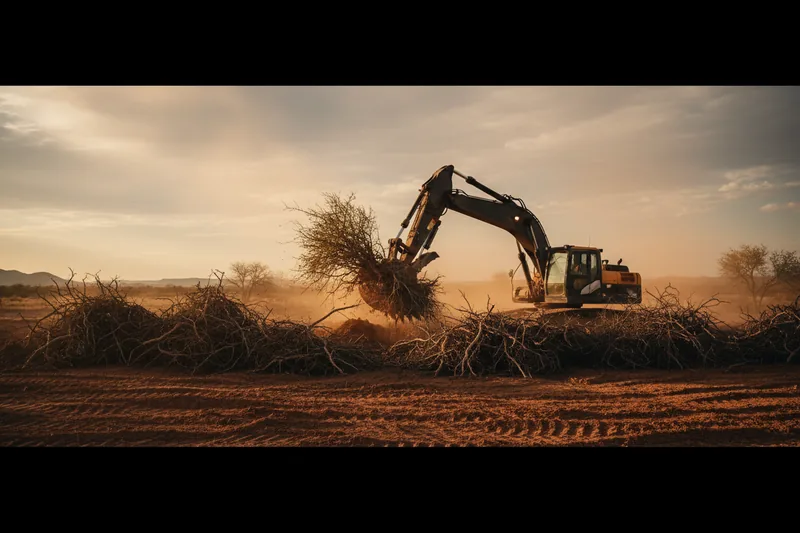
What does it cost to clear an acre of land in Texas?
In North Texas in 2026, land clearing runs $1,200 to $5,000 per acre. Light scattered mesquite on open pasture is $1,200 to $2,000. Moderate mesquite or cedar is $2,000 to $3,000, heavy multi-stem brush $3,000 to $4,000, and wooded, rocky or haul-off ground $4,000 to $5,000 or more. Density, method, terrain, access and debris handling decide where your acreage falls.
Cost per acre by density
The biggest single driver. These are the bands we use around Jacksboro.
| Density | What you are looking at | Cost per acre |
|---|---|---|
| Light | Scattered mesquite or brush on open pasture, mostly mowable | $1,200 – $2,000 |
| Moderate | Continuous mesquite or cedar, stems you have to work around | $2,000 – $3,000 |
| Heavy | Thick multi-stem mesquite, mature cedar, heavy undergrowth | $3,000 – $4,000 |
| Wooded | Hardwoods, rock and slope, or debris hauled off | $4,000 – $5,000+ |
These are 2026 ranges for North Texas ranch country, not quotes. Hill Country cedar, East Texas timber and city-edge lots price differently.
Cost per acre by method
The method you pick changes both the price and whether the brush comes back.
| Method | Best for | Cost per acre | Does mesquite come back? |
|---|---|---|---|
| Grubbing / rooting (excavator) | Mesquite you want gone for good, homesites, working around keeper trees | $2,000 – $5,000 | No, the root crown comes out |
| Dozer clearing or root plowing | Large pastures, bulk clearing, pasture reclamation | $1,200 – $3,500 | Not when root plowed below the crown |
| Forestry mulching | Cedar, brush, fence lines, trails, no debris to handle | $1,500 – $4,500 | Yes, the crown stays in the ground |
| Brush hog mowing | Keeping open pasture open, weeds and small brush | Not a clearing price. Maintenance, quoted per job | Yes, it only cuts the top |
Brush hog mowing is priced per job after we see the ground. Acreage, how tall and thick the growth is, rock and stumps hidden in the grass, and how far we haul the tractor drive that number.
What moves the price, factor by factor
1. Vegetation density
The biggest factor by a wide margin, and the reason nobody can quote you honestly over the phone. Twenty scattered mesquite per acre and a solid wall of them look the same on an aerial map. On the ground, one is a morning and the other is a week.
2. Mesquite and cedar size
Trunk size and stem count matter as much as how many trees there are. A single-trunk mesquite comes out of the ground in one lift. An old mesquite that has been shredded or pushed before has a wide crown with a dozen stems coming off it, and it takes longer to get all of it out. Cedar is simpler: cut below the lowest green limb and it is done, but a mature cedar with a trunk you cannot reach around takes more time and makes more debris than a young one.
3. Terrain
Slope slows every machine down. Rock near the surface can make rooting slow or force a change of method. Creeks, draws and wet spots have to be worked around, and ground near water may need a call to the county before anything is disturbed.
4. Access
Gate width decides what equipment fits through without cutting fence. Distance from the road adds travel time for the machines every day. Soft ground after rain can shut a job down until it dries out. A pasture with a wide gate on a county road is cheaper to clear than the same pasture at the back of a mile of two-track.
5. Method
See the method table above. Grubbing costs more per acre on heavy stands and ends the mesquite problem; here is the full mesquite grubbing cost per acre breakdown. Root plowing covers big acreage efficiently and also gets below the crown, but it turns the ground over, so plan on reseeding. Forestry mulching leaves a clean surface with no piles, and it is the right call on cedar, but it does not kill mesquite.
6. Burn, mulch or haul
What happens to the debris is often the second-biggest line on the bill. Piling or windrowing it for you to burn later is cheapest. Burning it ourselves depends on the county burn ban and TCEQ outdoor burning rules. Mulching grinds it in place, so there is no pile at all. Hauling it off is the most expensive and the cleanest, and on a big job it can be what pushes an acre into the top band.
One more: acreage. Loading, hauling and unloading machines costs about the same for two acres as for twenty, so small jobs carry that cost on fewer acres and the per-acre figure looks higher.
Why mesquite comes back when the roots stay
Mesquite regrows from a bud zone on the root crown, a few inches below the soil surface. If a contractor shears, mows, mulches or pushes it and leaves that crown in the ground, the plant comes back, typically within two to three years, and multi-stemmed. You end up with more stems per acre than before, and the next clearing job is harder than the first.
So the cheap quote is often not the cheap job. Clearing that has to be redone in three years costs more than clearing that does not. When you compare bids, the question to ask is not just the price. Ask: are you getting the root crown out, or cutting it off at the ground? The answer explains most of the difference between two numbers on the same property.
Cedar is mostly the opposite. Ashe juniper and eastern redcedar cut below the lowest green limb do not resprout (redberry juniper, more common to the west, can), which is why cedar acreage usually prices lower than mesquite of the same thickness, and why forestry mulching works so well on it.
How our range compares to other published Texas prices
You should not take one company's numbers on faith, so here is what others in Texas publish. They are in the same ballpark as ours.
- One large Texas land clearing contractor publishes about $1,300 to $4,000 per acre for Texas land clearing, once a job is big enough to spread the machine day across several acres.
- A North Texas forestry mulching company publishes $1,500 to $5,000 per acre for forestry mulching in Texas.
Differences come from region, the mix of cedar and mesquite, and what each company includes. Whoever you call, ask what is in the number: method, debris handling and finish.
Getting a real number
A per-acre number given sight-unseen is a guess. We walk the property, look at density, trunk size, slope, access and what you want left standing, and give you a number with the method spelled out. It costs nothing.
If you are in Jack, Wise, Young, Palo Pinto or Parker county, here is how we do land clearing, including mesquite grubbing, dozer clearing and root plowing and forestry mulching.
Questions people ask us
Do you need a permit to clear land in Texas?
For clearing your own private property, generally no. There is no statewide land clearing permit. It changes near water: work in or around a creek, wetland or mapped floodplain can trigger county floodplain rules or federal Clean Water Act permitting. Burning debris is governed by county burn bans and TCEQ outdoor burning rules, and cities and some subdivisions have their own tree rules. Check with your county before you start.
What is the cheapest way to clear land?
Per acre, a dozer over open acreage with debris piled on site for you to burn later, or root plowing on big pastures. On established mesquite, a method that leaves the crown in the ground may just be the cheapest way to buy the same job twice. On cedar, forestry mulching is often the best value because there is no debris to deal with.
Is forestry mulching cheaper than dozer clearing?
Not usually. Around here mulching runs about $1,500 to $4,500 an acre and dozer clearing or root plowing about $1,200 to $3,500. Mulching saves you the burn piles or haul-off and leaves the grass in better shape. On cedar and brush it is a great choice. On mesquite it leaves the root crown, so expect regrowth.
How much does brush hog mowing cost per acre?
We do not price brush hog mowing with the clearing range. It is maintenance on ground that is already open, so we quote it per job after seeing it. Acreage, how tall and thick the growth is, hidden stumps and rock, and travel distance drive the price.
How long does it take to clear an acre?
Light brush with a dozer: several acres in a day. Heavy mesquite grubbed tree by tree with an excavator: most of a day for a single acre. That spread is the same reason the price range is so wide.
Can I clear it myself with a rented machine?
For light brush on a small tract, sometimes. Rental, fuel, hauling and your weekends add up faster than people expect, and getting mesquite out by the root takes the right machine and seat time. Cutting cedar with a chainsaw on a few acres is honest work you can do yourself.
Does clearing increase property value?
Usually, on rural property. Cleared, usable acreage shows better than brush and restores grazing. Clearing can also matter for keeping an agricultural valuation current, so talk to your county appraisal district before you make decisions on that basis.
Want a number on your place?
Tell us the acreage and roughly how thick it is. We will come walk it, free, and put a real figure in your hand. Call 940-567-8111.