Around Jacksboro, forestry mulching generally runs $1,500 to $4,500 per acre in 2026. Light brush and scattered young cedar sit at the bottom of that range. Thick mature cedar, heavy undergrowth, rock and slope push it toward the top. Those are ranges, not quotes. We walk the ground for free and give you a real number for your acreage.
What a forestry mulcher actually does
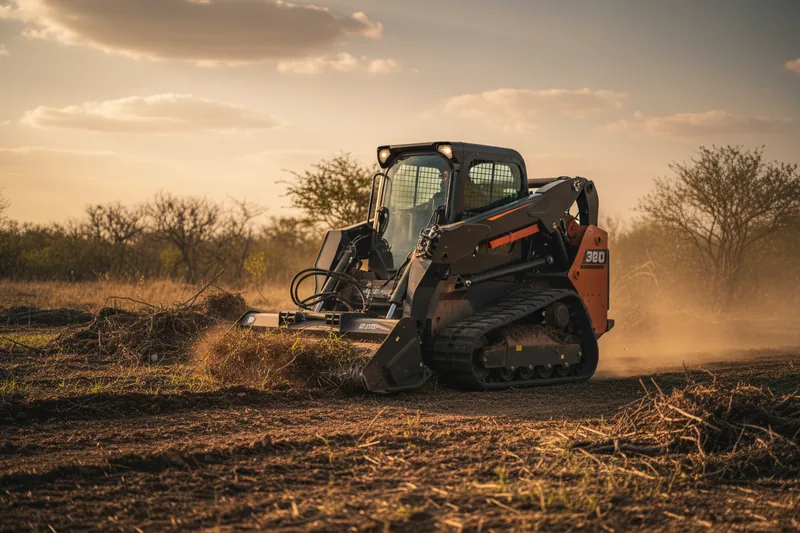
A forestry mulcher is a heavy rotary drum lined with steel teeth, mounted on a tracked machine. It is driven into standing brush and trees and grinds them, trunk and limbs, into chips that fall and spread across the ground. Stumps are ground down at or near ground level.
That is the whole appeal. One pass takes the brush down and deals with the debris at the same time. There is no windrow to push up, no burn pile sitting there waiting on a burn ban to lift, and no truckloads going down the road. The mulch layer left behind shades the soil, slows runoff and breaks down over time.
Because the mulcher works from the top down and does not dig, the ground is not torn up. No root balls pulled, no holes to fill, no bare dirt left to wash in the next hard rain.
Where mulching is the right call
These are the jobs we recommend it for.
Cedar
Ashe juniper and eastern redcedar do not resprout. Cut below the lowest green limb, they are done, so grinding them to the ground is a permanent result. Redberry juniper, more common to the west, can sprout back from the base, so we check which you have.
No regrowth from Ashe juniper stumps
No burn piles of green cedar
Fence lines
Brush grown into the wire gets ground back without dragging the fence down with it or piling debris against it.
Opens the line back up
Debris stays small and flat
Trails & lanes
Hunting lanes, trails through a wooded tract, and the two-track to the back of the place, opened up without scraping the ground bare.
Selective width
Ground stays covered
Wooded lots & homesites
Undergrowth and small trees taken out from under the oaks you want to keep, so a lot opens up without looking bulldozed.
Works around keeper trees
Little soil disturbance
Forestry mulching cost per acre
2026 ranges for our area. Your number comes after we walk it.
Forestry mulching cost per acre, North Texas, 2026
Density
What that looks like
Typical cost per acre
Light
Scattered young cedar and brush, open ground, easy access
$1,500 – $2,500
Moderate
Continuous cedar or brush 6–15 ft, some larger trunks
$2,500 – $3,500
Heavy
Mature cedar, thick undergrowth, rock or slope
$3,500 – $4,500
What moves it: how thick it is and how big the trunks are, rock (it is hard on mulcher teeth), slope, creeks and draws, and access through your gates. Mulching fits inside our overall land clearing range of $1,200 to $5,000 per acre.
Mulching compared with the other methods
Mulching leaves the ground covered and largely undisturbed, with nothing to burn. It does not remove roots. Best on cedar, brush and selective work.
Grubbing with an excavator lifts the root ball out. Slower per tree and leaves holes and piles, but mesquite does not come back.
Dozer clearing and root plowing cover big acreage fast and get below the crown when root plowed, but they disturb the soil and the grass, and you are left with stacks to burn or haul.
Plenty of places need more than one of these. We will tell you which parts of your ground want which method before anything starts.
Questions people ask us
Does forestry mulching kill mesquite?
No. It grinds the top off and leaves the root crown in the ground, and mesquite resprouts from that crown. Expect multiple new stems within a couple of growing seasons. To get rid of mesquite, it has to be rooted out below the crown.
Is forestry mulching good for cedar?
Yes, it is one of the best uses for it. Ashe juniper and eastern redcedar do not resprout once cut below the lowest green limb, so mulched cedar stays gone, and you are not left with piles of green cedar to burn. Redberry juniper is the exception: it can resprout from the base, and we will tell you if that is what you have.
What happens to the mulch?
It stays on the ground as a layer of chips. It helps hold soil and moisture and breaks down over time. Heavy stands leave a thicker layer, which can slow grass coming back in the thickest spots for a while.
Do I need to wait on a burn ban?
No. Nothing gets burned, so county burn bans do not hold up a mulching job the way they can hold up a pile-and-burn clearing job.
Can you mulch around trees I want to keep?
Yes. Mark the oaks or anything else you want left and we will work around them. Mulching is well suited to thinning out undergrowth under trees you are keeping.
Is there forestry mulching near me?
If you are in Jack, Wise, Young, Palo Pinto or Parker county, yes. We work out of Jacksboro and cover Bryson, Graham, Mineral Wells, Bridgeport, Decatur, Weatherford and the country between. Call 940-567-8111 for a free estimate.
Where we work
We are based in Jacksboro and work out from there across Jack, Wise, Young, Palo Pinto and Parker counties. If you are close to the edge of that circle, call and ask — we will tell you straight whether it is worth the drive for both of us.