
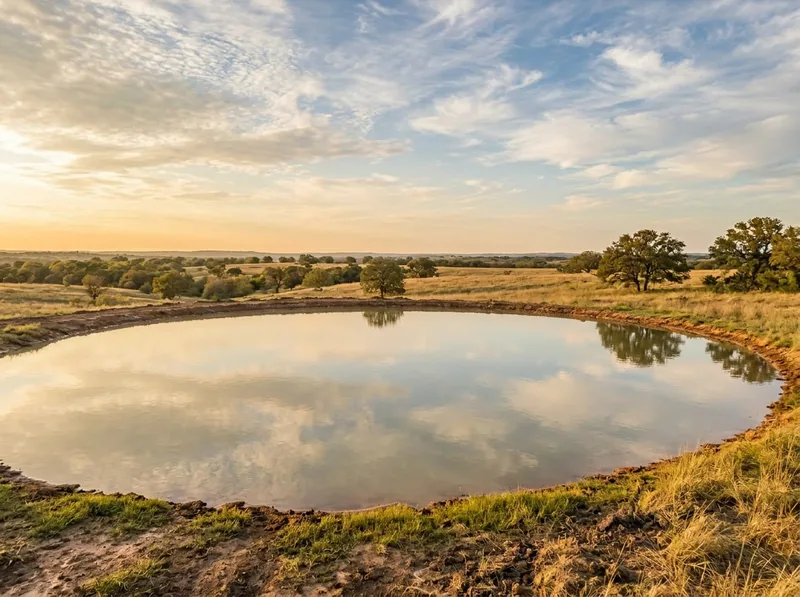
Site evaluation
Soil, watershed and topography, walked before anything is quoted. Free.
Pond builders · Stock tank ponds & cleanouts
Half of pond building is knowing where to put it and what the dirt underneath will do. The digging is the easy part.
Call 940-567-8111 Get a free estimate
Free on-site estimates · Jack, Wise, Young, Palo Pinto and Parker counties
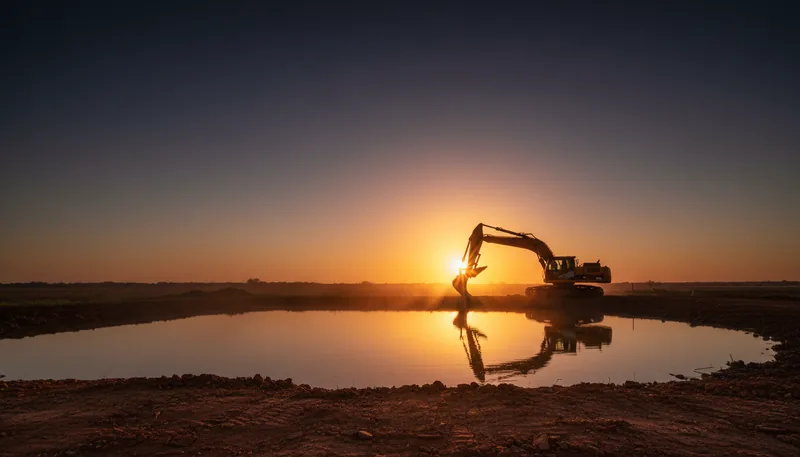
Every stock tank is quoted per job after we walk the site, because the cost comes down to size, depth, how much dirt has to move, and whether the site holds water without help. A cleanout of an existing silted tank is its own, simpler job. The number that matters more than the price, though, is whether the site will hold at all — soil with enough clay content will seal itself, and sandy or rocky ground may not hold without a clay liner. We evaluate that on-site before quoting, free.
Looking for pond builders near you in Jack, Wise, Young, Palo Pinto or Parker county? We dig new stock tank ponds and clean out old ones across all five, working out of Jacksboro to Bryson, Graham, Bridgeport, Decatur, Mineral Wells, Graford, Springtown and Weatherford. Most of what we build is a working stock tank pond for cattle, horses or wildlife on a ranch or acreage, not a decorative backyard pond.
Every pond is quoted per job after we walk the site, because soil, the lay of the land and the watershed change the job more than the size does. For what goes into the number, read our guide to the cost to build a pond or stock tank in Texas.
The most expensive mistake in pond building is digging a beautiful tank in the wrong spot. A hole that does not hold water is just a hole, and fixing it afterward costs more than siting it correctly would have.
Three things decide it. Soil — you want clay content; a good tank site essentially seals itself as the fines settle. Sandy or fractured limestone ground may need a clay liner hauled in and keyed, which is real money. Watershed — the tank has to catch enough runoff to fill and stay full through a Texas summer, which means you need enough acreage draining to it, but not so much that a big rain blows out the dam. And topography — a natural draw lets you build a shorter dam and move less dirt for the same volume of water, which is where most of the savings live.
We walk all three before we quote. If your preferred spot is a bad spot, we would rather tell you that and suggest a better one fifty yards away than take the money and dig it where you pointed.
A lot of the tanks around here were built decades ago and have silted in to where they hold a fraction of the water they once did. Cleaning one back out to depth is usually far cheaper than building new — the dam and the site are already proven — and the spoil you take out is often exactly the fill somebody needs for a pad on the same place.
Soil, watershed and topography, walked before anything is quoted. Free.
Built and keyed into the ground properly, compacted in lifts. A dam is a structure, not a pile of dirt.
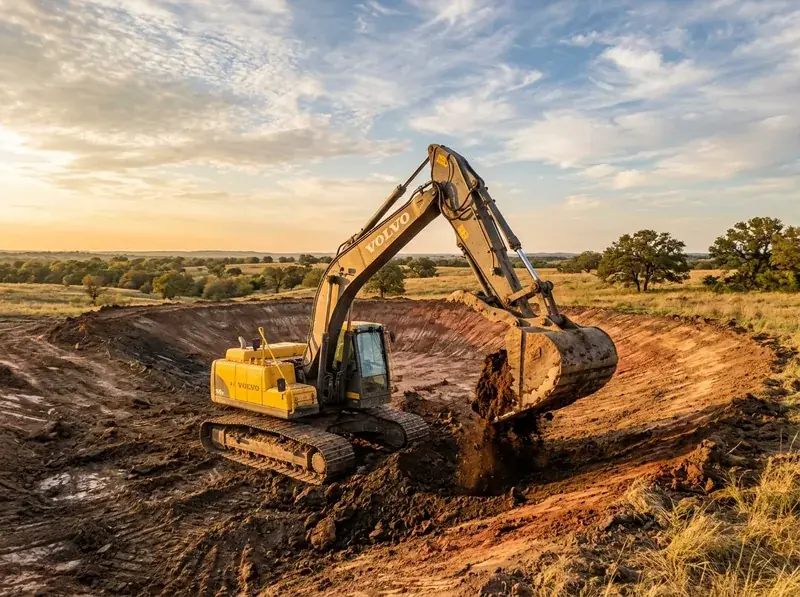
Dug deep enough to survive a dry summer, with the shape and slope that suit what you want it for.
Sized so a heavy rain leaves without taking your dam with it. This is where undersized ponds fail.
Existing tanks dug back to original depth, silt removed and spread or hauled.
The dirt that comes out often becomes a pad or a road on the same property, which saves you a separate haul.
Deeper than people expect. Shallow water heats up, grows algae, and evaporates hard through a Texas August. You want a meaningful area of genuine depth so there is cool water and reserve volume when it stops raining in July. We will talk through depth against your budget on-site — it is the dimension most worth spending on.
For a normal stock tank on your own property catching runoff, usually not. It gets more involved if you are damming a defined watercourse, if the impoundment is large, or if you are in a mapped floodplain — those can involve the county or the Texas Commission on Environmental Quality. We will flag it if your site looks like one of those cases.
Entirely down to rain. That is why the watershed calculation matters — a properly sited tank on adequate drainage can come up substantially in one good spring; an undersized watershed can leave a perfectly built tank half empty for a year.
Then we tell you before we dig. Options are a clay liner keyed into the basin, a bentonite treatment, or moving the tank to better ground on the same place. All three cost money; digging first and finding out later costs more.
Usually we want it drawn down or dry, which is why cleanouts are typically a late-summer or drought job. Sometimes we can work a wet one from the bank. We will look at it.
If you are in Jack, Wise, Young, Palo Pinto or Parker county, yes. We build and clean out stock tank ponds from Jacksboro out to Bryson, Graham, Bridgeport, Decatur, Mineral Wells, Graford and Weatherford. Near the edge of that area? Call and we will tell you straight whether it is worth the drive for both of us.
We are based in Jacksboro and work out from there across Jack, Wise, Young, Palo Pinto and Parker counties. If you are close to the edge of that circle, call and ask — we will tell you straight whether it is worth the drive for both of us.
Show us the spot you have in mind. We will tell you honestly whether it will hold and what it would take.