
Guide · October 2026
How much does it cost to build a pond or stock tank in Texas?
Short version: it depends on how much dirt has to move and whether the ground will hold water once it is dug. Here is what goes into the number, so you know what you are paying for before anybody brings a machine.
Call 940-567-8111 Get a free estimate
Free on-site estimates · Jack, Wise, Young, Palo Pinto and Parker counties
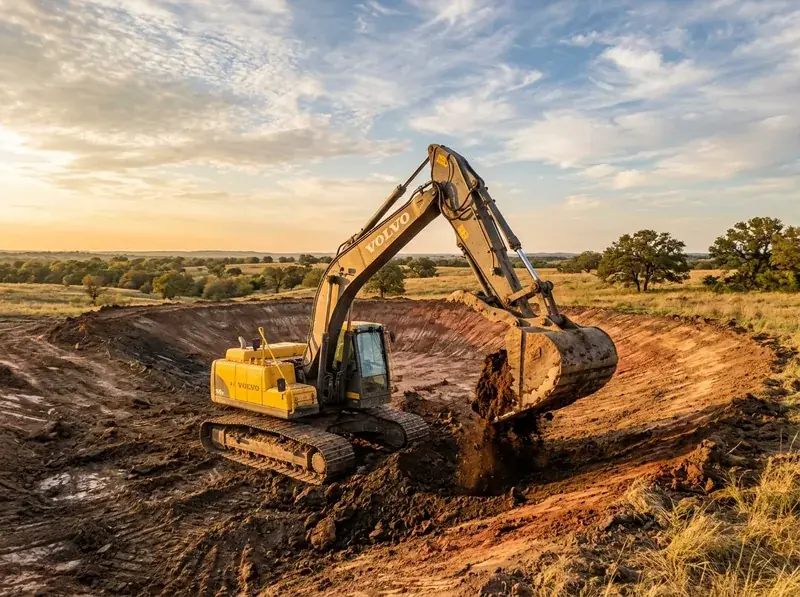
How much does it cost to build a pond or stock tank in Texas?
There is no honest flat price for a pond: the cost comes from how much dirt has to move and whether the ground will hold water once it is dug. Size and depth, clay content, the watershed and spillway, access, clearing the footprint and where the dirt goes set the number. We quote ponds and stock tanks per job after walking the site, and the estimate is free.
What drives the cost of a pond
Eight things decide the price of digging a pond or stock tank. Here is what keeps each one cheap and what makes it expensive.
| Factor | Costs less when | Costs more when |
|---|---|---|
| Size and depth | The tank is sized to what you need it for | Big surface area and deep water mean more cubic yards dug and moved |
| Soil | There is enough clay to seal the basin | Sandy or fractured rock ground needs a clay liner or bentonite |
| Lay of the land | A natural draw lets a short dam hold the water | Flat ground means the storage has to be dug out |
| Watershed and spillway | Drainage area is the right size for the tank | A big drainage needs a wider spillway and a stronger dam |
| Access | Open gates, firm ground, close to the road | Narrow gates, soft ground, a long way in |
| Clearing the footprint | It is open pasture | Mesquite and cedar have to come off the basin and dam first |
| Where the dirt goes | Spoil builds the dam or a pad on the same place | Spoil is hauled off, or clay is hauled in |
| Permits | An exempt stock tank on your own land, away from creeks | A creek, wetland or mapped floodplain is involved |
We do not publish a pond price. Every one of these is site-specific, and we quote ponds per job after walking the ground.
What moves the price, factor by factor
1. Size and depth
Most of a pond bill is dirt moved, and dirt moved is measured in cubic yards. Double the surface area or go meaningfully deeper and the yardage goes up with it. Depth is still the dimension most worth paying for here. Shallow water heats up, grows algae and evaporates hard through a Texas August, and a tank with real depth in it still has water when it stops raining in July.
2. Soil, and whether it will hold water
This is the one that decides whether you get a pond or an expensive hole. Ground with enough clay in it seals itself as the fines settle into the bottom. Sandy ground, gravel or fractured limestone may not hold without help: a clay liner hauled in and keyed into the basin, or a bentonite treatment. Either one is real money, and finding out after the tank is dug costs more than finding out before. We look at the dirt before we quote, and if it does not look like it will hold, we tell you.
3. The lay of the land
A natural draw is the cheapest place to store water, because a dam across it holds water above the ground the draw already gives you. On flat ground there is no help from the terrain: every gallon of storage has to be dug out, and every yard of it has to go somewhere. Moving the tank fifty yards to better ground can change the dirt bill more than anything else on this list.
4. Watershed and spillway
The tank has to catch enough runoff to fill and stay full through a summer, which means enough acreage draining to it. Too much drainage is a problem too. A big rain on a big watershed has to leave over the spillway without cutting the dam, so the spillway is sized for what the drainage can send at it. An undersized spillway is where a lot of ponds fail, and fixing a breached dam costs more than building the spillway right.
5. Access
Gate width, how far the site is from the road, soft ground and creek crossings all matter. A dozer and an excavator have to get to the site and work there for days, and a tank site that is hard to reach takes longer to build.
6. Clearing the footprint
Brush and trees have to come off the basin and the dam footprint, roots and all. Roots rotting in a dam leave voids that water finds. If the site is in mesquite or cedar, that clearing is part of the job, priced like any other land clearing.
7. Where the dirt goes
Dirt from the basin usually builds the dam. What is left over can become a house or barn pad, or fill for a low spot on the same place, which saves you paying for that fill twice. Hauling spoil off the property, or hauling clay in for a liner, is where pond costs climb.
8. Permits
A stock tank on your own land, catching runoff away from any creek, usually needs no permit. Damming a defined creek, building a large reservoir, or working in a wetland or floodplain is a different conversation. More on that below.
Cleaning out an old tank versus building new
A lot of the tanks around here were built decades ago and have silted in to a fraction of the water they once held. Cleaning one back to depth is usually far cheaper than building a new one: the dam is already there, and the site has already proved it holds water. The silt that comes out can often be spread or used as fill on the same place.
Cleanouts work best when the tank is drawn down or dry, which is why they tend to be a late-summer or drought job. A dry spell that has your tank low is a good time to call.
Texas water rights and permits: the basics
Surface water in Texas belongs to the state, and using it generally takes permission from the Texas Commission on Environmental Quality (TCEQ). There are exceptions, and stock tanks are the big one for landowners.
Texas Water Code §11.142(a) says that without a permit, a person may build on their own property a dam or reservoir with normal storage of not more than 200 acre-feet of water for domestic and livestock purposes. The same section says that exemption does not apply to a commercial operation. TCEQ lists domestic and livestock use among the exempt uses on its water rights page, and notes there that diffuse rainfall runoff, before it reaches a watercourse, is not state water.
200 acre-feet is a lot of water. A tank would have to average 10 feet deep across 20 surface acres to hold it. The limit is on normal storage. The statute also allows temporarily storing more than 200 acre-feet, as long as the tank has not held more than that on average in any 12-month period.
Federal rules can come into it near water. The EPA lists construction and maintenance of farm or stock ponds among the exemptions from Clean Water Act Section 404 permits, but not where the work is a new use of the water that reduces the reach or impairs the flow of regulated waters, and filling a wetland generally needs a permit. If your site is in a creek bed, a wet bottom or a mapped floodplain, check with the county before anyone digs.
This is general information, not legal advice. For help with design and siting, your county Extension agent and the local USDA NRCS field office are good places to ask. NRCS publishes a conservation practice standard for ponds, Pond (Code 378).
Questions to ask any pond builder
- Have you looked at the soil, and what happens if it does not hold?
- How deep will it be, and what is the average depth, not just the deepest spot?
- How big is the drainage above it, and how is the spillway sized?
- How is the dam built: stripped of topsoil and roots, keyed in, and compacted in lifts?
- Where does the spoil go, and is hauling in the price?
- Is clearing the site in the price?
Getting a real number
If you are in Jack, Wise, Young, Palo Pinto or Parker county, here is how we build and clean out stock tanks and ponds. Show us the spot you have in mind. We will tell you honestly whether it will hold, what it would take, and what it would cost. If the site needs clearing first or the spoil can become a pad, see land clearing and dirt work.
Questions people ask us
How much does it cost to build a pond in Texas?
It depends on the site, which is why we quote ponds per job after walking it. The biggest drivers are how many cubic yards of dirt have to move, whether the soil holds water without a liner, the lay of the land, the spillway, access, clearing the footprint and where the spoil goes. The estimate is free.
How much does it cost to dig a stock tank?
Most of the cost of digging a stock tank is dirt moved, so size, depth and the shape of the ground decide most of it. A tank in a natural draw usually takes less dirt work for the same water than one dug out on flat ground. Soil that will not hold, a long haul for spoil or clay, and brush on the site all add to it.
Do I need a permit to build a stock tank in Texas?
Often not. Texas Water Code §11.142(a) lets a person build on their own property, without a permit, a dam or reservoir with normal storage of not more than 200 acre-feet for domestic and livestock purposes, and that exemption does not apply to a commercial operation. Work in a creek, wetland or mapped floodplain can bring in other rules, so check with the county first.
Is cleaning out an old tank cheaper than building a new one?
Usually, yes. The dam is already built and the site has already proved it holds water. Cleanouts go best when the tank is drawn down or dry, so late summer and dry spells are the time to do them.
What if my ground will not hold water?
Then you want to know before the tank is dug. The options are a clay liner keyed into the basin, a bentonite treatment, or moving the tank to better ground on the same place. All three cost money. Digging first and finding out later costs more.
How deep should a stock tank be in North Texas?
Deeper than most people expect. Shallow water heats up, grows algae and evaporates hard in a Texas summer. You want a good area of real depth so there is cool water and reserve volume when it stops raining. Depth is the dimension most worth spending on.
Thinking about a tank?
Show us the spot you have in mind. We will walk it, free, and tell you whether it will hold, what it would take, and what it would cost. Call 940-567-8111.